


Patents, designs and trade marks underpin almost half of Europe’s GDP, yet they still carry little weight when companies seek financing. Brussels wants to reverse this situation, and businesses should start preparing now. By Manuel Campanero Carrasco, Economist. Director of PONS IP Andalucía
There is one figure in the latest European Union Intellectual Property Office (EUIPO) report that deserves particular attention: only 13% of intellectual property rights holders have ever attempted to obtain financing by leveraging those rights. The vast majority have never commissioned a professional valuation of their intangible assets.
We are talking about patents, registered designs, trade marks, software, trade secrets and protected technical know-how. In other words, the assets that underpin the competitive position of a significant proportion of Spain’s industrial base.
The figure is striking because, at the same time, IP-intensive industries account for approximately 48% of the European Union’s GDP and 31% of employment. We have an economy built on intangible assets and a financial system that barely acknowledges them. The IP-backed Finance report, published by EUIPO in April 2026, is dedicated precisely to explaining why this disconnect exists and what infrastructure needs to be developed to address it.
Its underlying conclusion should be of interest to any finance director, regardless of whether they operate in a technology-driven sector. Europe does not have an ideas problem. It has a problem financing the commercialisation of those ideas.
A €365 Billion Credit Gap
The report estimates the SME financing gap across the European Union at up to €365 billion per year. Of this amount, the share attributable to IP-intensive businesses, the market that could potentially be served through financing instruments backed by intangible assets, is estimated at between €70 billion and €150 billion annually.
Were the appropriate infrastructure to be established, EUIPO estimates that such instruments could mobilise between €30 billion and €120 billion in additional financing each year. Over a ten-year period, this would represent between €150 billion and €580 billion, with a cumulative impact on EU GDP ranging from 0.4% to 4.2%.
The Three Barriers Holding It Back
The conventional explanation is that intangible assets are difficult to value. That is true, but incomplete. The report identifies three interconnected layers of obstacles.
The first relates to the nature of the asset itself. A patent, a registered design or a portfolio of proprietary developments does not behave like an industrial building. There is an inherent information asymmetry between those who created the asset and those expected to finance against it. Its value often depends on complementary assets that cannot easily be transferred alongside it: the team, commercial network and organisational know-how behind it. Detached from that context and assessed in a piecemeal liquidation scenario, it may be worth only a fraction of its value in use. Moreover, every intangible asset is unique, with very few comparable transactions available as benchmarks.
The second barrier stems from regulation and market structure. Accounting standards prevent companies from recognising most internally generated intangible assets on their balance sheets. As a result, the businesses that invest most heavily in developing these assets are often those that reflect them least effectively in their financial statements. Secondary markets for such assets remain underdeveloped, limiting the availability of reference prices. Security interests over intangible assets are not harmonised across EU Member States. In addition, the Basel III prudential framework increases the capital requirements imposed on lenders accepting this form of collateral.
The third obstacle is cost. A bespoke valuation requires significant analytical work, there are relatively few suitably qualified professionals, and the resulting valuation can be difficult to benchmark against market evidence. For many SMEs, the cost of obtaining a valuation may be disproportionate to the financing transaction being sought.
The outcome is a self-reinforcing cycle that the report describes in unequivocal terms: without transactions, there is no data; without data, risk assessment remains conservative; and without reliable risk assessment, no financing instrument can achieve scale.
What Is Currently Being Built
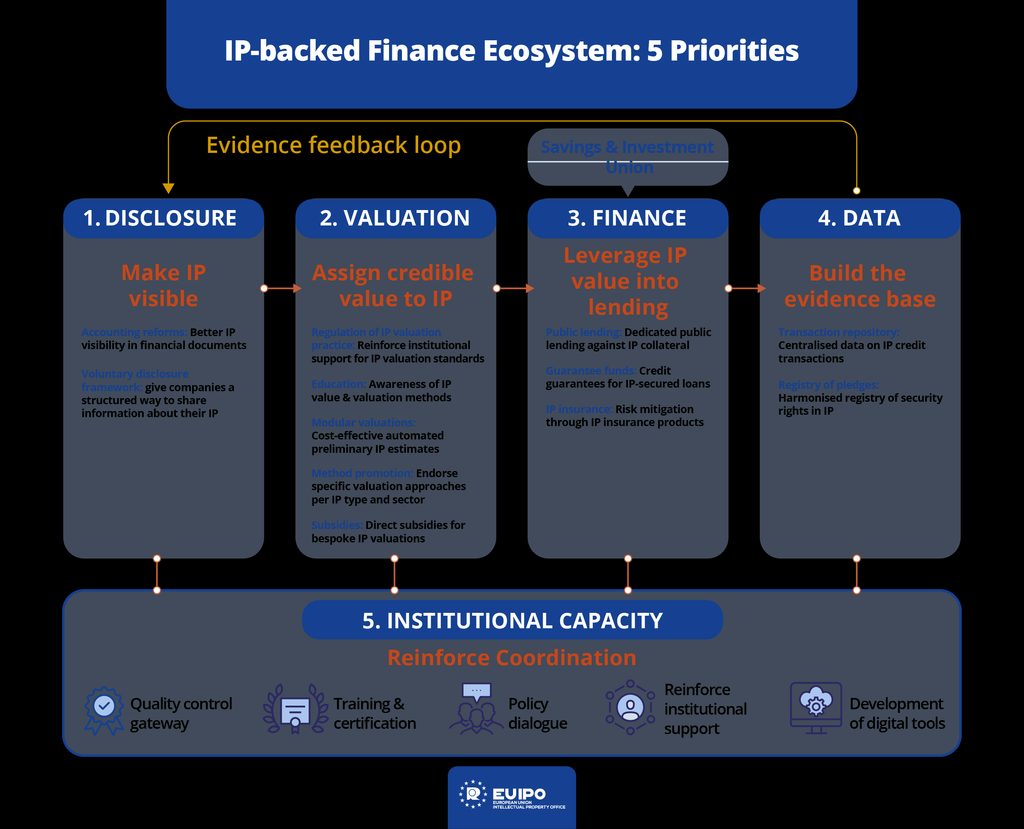
The report proposes 18 possible measures and identifies five interconnected priorities. Understanding this sequence is important because it provides a clear indication of how the market is likely to evolve.
First, intangible assets must be made visible through a voluntary disclosure framework, without imposing additional reporting obligations and drawing on the diagnostic tools already available through the SME Fund.
Second, those assets must be assigned a credible value using a European valuation architecture aligned with international standards, supported by training initiatives and, eventually, certification pathways.
Third, that value must be translated into actual lending through risk-sharing instruments: dedicated guarantee products that also reduce capital burdens for lenders, public lending backed by intangible assets, and insurance products covering infringement and enforcement risks.
Fourth, a database of real transactions should be developed, accompanied by a centralised register of security interests that would enable lenders to verify whether an asset has already been pledged.
Finally, all these elements must be coordinated to operate consistently across Member States.
The timetable is already advancing through parallel legislative initiatives. The insolvency harmonisation directive, endorsed by the European Parliament in March 2026, introduces pre-pack sales, enabling businesses and their intangible assets to be transferred before formal insolvency proceedings commence, thereby preserving the context on which much of their value depends. Its transposition period is expected to be approximately 33 months. At the same time, the proposed regulation establishing a 28th company law regime and the review of the venture capital framework, scheduled for the third quarter of 2026, form part of the wider package.
All of this sits within the broader framework of the Savings and Investments Union. Here lies the report’s central message: capital does not automatically flow towards innovative businesses. It flows towards assets and opportunities that can be assessed, valued and deployed with confidence. If the necessary infrastructure is not in place, that capital will migrate towards sectors offering traditional forms of collateral or towards markets with more mature frameworks, rather than supporting Europe’s knowledge-intensive businesses.
What Companies Can Do Now
The temptation may be to wait until the framework is fully developed. That would be a mistake, because much of the essential groundwork can already be undertaken.
Understand What You Own
Companies should maintain a structured inventory of registered and unregistered rights, ownership arrangements, renewal dates, territorial coverage and their direct connection to revenue streams. While this may sound straightforward, it is rarely documented to the level of detail required by a risk analyst.
Determine Whether Assets Are Unencumbered
Security interests, pledges, exclusive licences and contractual restrictions affecting asset availability should be identified. In the absence of a centralised register, this process remains largely manual and is best undertaken before any third party requests it.
Review Security Structures
The legal requirements for creating security interests vary depending on the asset concerned and the applicable jurisdiction. For European Union titles, registering a security interest is voluntary but highly advisable. However, the intellectual property office merely records and publishes the interest; it does not verify whether it has been validly established. Validity and priority remain matters of national law. A published but improperly constituted security interest may provide visibility to third parties while offering little practical enforceability.
Begin With an Indicative Valuation
There is no need to commission a comprehensive valuation report from the outset. A preliminary assessment can help determine whether an asset is likely to support financing discussions with a lender. Only where justified should this be escalated to a full valuation exercise.
Organise Information Before It Is Needed
As IP-backed financing instruments become available, businesses that have already documented and assessed their intangible asset portfolios will be first in line. Others may find themselves beginning a process that can take months to complete.
For decades, intellectual property has largely been treated as a legal matter, managed by legal departments and viewed primarily as a cost centre. The EUIPO report suggests a fundamental shift: intellectual property is becoming a financial asset class.
For many mid-sized Spanish businesses, with portfolios of patents, designs, trade marks and technical know-how built up over decades but scarcely reflected on their balance sheets, this is not a distant regulatory development. It may well determine whether they gain access to the financing that is expected to be mobilised over the coming years.
Copilot said:
Ultimately, turning intellectual property into a genuine source of finance requires far more than simply holding registered rights. It requires identifying intangible assets, understanding how they contribute to the business, organising the relevant information, and building a robust valuation framework that investors and financial institutions can trust. At PONS IP, our Technology Consulting team supports companies and organisations throughout this process, combining technical, economic and strategic expertise to analyse their assets, strengthen their management and prepare them for financing, investment and growth opportunities. Because the value of innovation depends not only on protecting it, but also on knowing how to explain it, measure it and align it with business objectives. If your organisation would like to better understand the potential of its intangible assets and move towards a value-driven approach to intellectual property management, get in touch with our team.


