

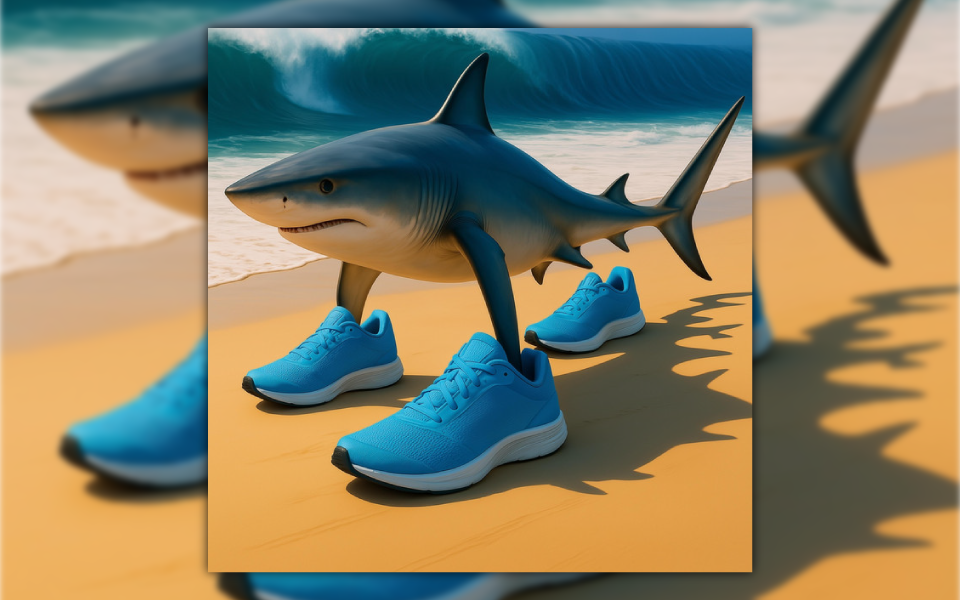
In early 2025, a trend took social media by storm, particularly on TikTok. This phenomenon, known as Italian Brainrot, is based on the creation of unique characters that combine absurd humour, a distinctive aesthetic and AI-generated content. Thus, animals and objects with surrealist features are created, i.e., extravagant and fantastical characters. This gave rise to millions of memes that users shared widely. The character who started this trend was Tralalero Tralala, a shark who wore Nike trainers and recited tongue twisters in Italian. This character became one of the most iconic, and the phrase “Tralalero Tralala” came to be a symbol of this phenomenon.[1]
It is unclear who created these characters, as many of them were initially generated using artificial intelligence tools; subsequently, users not only consumed the content but also actively participated in its development, adding variations and new elements.
This has given rise to a number of legal implications when it comes to determining who holds the rights to these creations, given that numerous users have been involved in their creation. In this regard, as this is a phenomenon arising from collective participation on the internet, it is not clear whether there is a single rights holder. This situation has a direct impact on determining who may be entitled to register a trademark associated with this phenomenon.[2]
Despite this context of vague origins and the apparent absence of a single owner, in late 2025 the Italian company Officina Comunicazione S.R.L. filed applications to register the word mark “TRALALERO TRALALA” in several countries. This action raises important legal questions. In particular, it raises the question of whether a single company can legally claim ownership of something that was created and shared by a community of internet users.
At this point, the analysis focuses on the tension between two distinct approaches: on the one hand, the collective, viral and decentralised nature of internet memes; and on the other, the principles of trademark law, which requires an identifiable owner and a sign that serves to indicate commercial origin. This tension raises the question of whether it is possible to “privatise” a global digital cultural phenomenon through registration.
Broadly speaking, the purpose of trademark registrations is to protect distinctive signs that identify goods or services in the market. In this case, the question arises as to whether Officina Comunicazione S.R.L. was entitled to register the name of a character whose origins are unclear and linked to artificial intelligence. However, this is not an isolated case: globally, there have been numerous applications for registration relating to Italian Brainrot. Under the first-to-file principle, in each jurisdiction exclusive rights are generally granted to the first applicant, without it being necessary for that applicant to be the creator of the sign, since the function of a trademark is to indicate the commercial origin, not authorship.
On the one hand, the relevant authorities merely verify compliance with formal requirements, such as the proper representation of the sign, the correct identification of the goods or services, and the absence of any legal prohibitions. This process does not examine the authorship of the sign, which is particularly problematic in phenomena such as Italian Brainrot, characterised by its collective creation and the use of artificial intelligence, where identifying an author is difficult in practice.
It is precisely because of this difficulty that the system sets certain limits. The regulations therefore prohibit registrations made in bad faith, defined as cases where the intention is to harm the legitimate interests of third parties or to misappropriate the rights of others. In this regard, a registration could be challenged if it conflicts with pre-existing copyright, provided that the party raising the challenge can prove their legitimate ownership and the originality of the work.
Furthermore, another difficulty that may arise when registering these trademarks is the lack of distinctiveness of the signs. For a trade mark to be susceptible to registration, it must be distinctive, In other words, it must serve to identify the commercial origin of the goods or services.
In this context, given that this phenomenon went viral, the question arises as to whether such widespread dissemination might affect its distinctiveness. Indeed, it could be argued that the sign loses its ability to distinguish itself from others by failing to fully fulfil its function of identifying the commercial origin, particularly given that numerous users have been involved in the creation and dissemination of these characters.
Furthermore, given that many users employ the phrase “tralalero tralala” as part of a meme, it could be argued that it functions more as a humorous reference than as a distinctive sign capable of identifying the commercial origin of goods or services.
Consequently, the case raises a broader issue: the growing trend of registering memes as trademarks. This opens up the debate as to whether the intellectual property system is being used to appropriate collective cultural phenomena, and whether such use is compatible with the essential function of trademarks.
Finally, this scenario highlights the fact that the registration of viral internet content faces not only technical challenges relating to distinctiveness and authorship, but also a fundamental issue: the boundaries between collective digital creation and private ownership through intellectual property rights.
Written by: Stephanie Ortiz Rey. Junior Lawyer PONS IP Colombia.
[1] https://www.infobae.com/virales/2025/04/17/el-fenomeno-del-brainrot-italiano-la-fiebre-viral-que-mezcla-inteligencia-artificial-estetica-surrealista-y-humor-absurdo/
[2] https://english.elpais.com/economy-and-business/2025-11-22/tiktok-italian-brainrot-and-trademarks-who-owns-the-rights-to-tralalero-tralala.html


