

Investment in intangible assets has grown more than three times faster than investment in physical assets since 2008, according to WIPO’s latest report
The global economy has reached a historic turning point. For the first time, investment in intangible assets accounts for a larger share of GDP than investment in tangible assets, confirming the transition towards an economy driven by knowledge, innovation, data, brands, software and intellectual property.
This is one of the key findings of World Intangible Investment Highlights 2026, published by the World Intellectual Property Organization (WIPO) and Luiss Business School. The full report is available here: World Intangible Investment Highlights 2026.
The study reveals a profound structural shift in the global economy. In 2025, intangible assets accounted for 12.8% of GDP across the economies analysed, compared with 11.8% for tangible assets. This trend highlights how value creation increasingly depends on non-physical assets such as research and development, software, databases, brands, design, organisational know-how and other forms of intellectual property.
More than 10 trillion dollars invested in intangible assets
Global investment in intangible assets reached a record high of more than 10 trillion dollars in 2025, consolidating a trend that has accelerated over the past two decades.
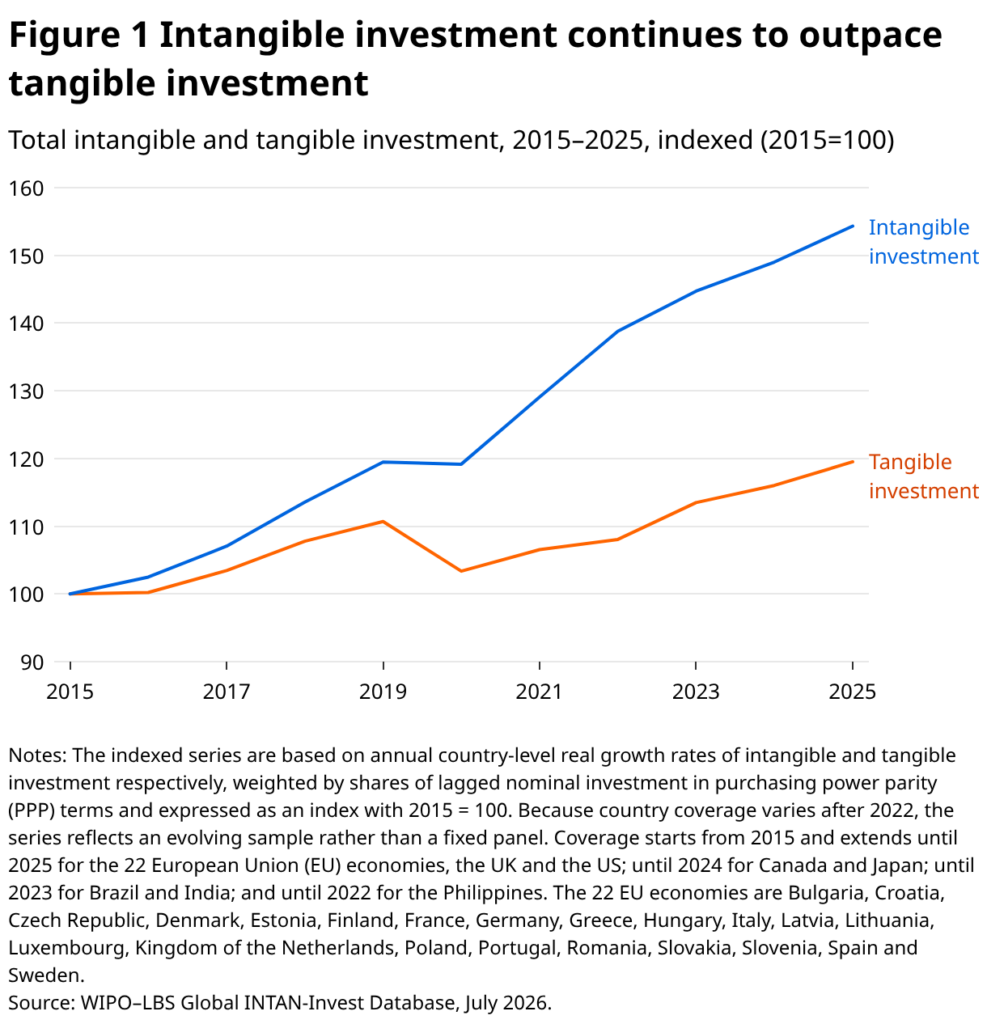
Since 2008, investment in intangibles has grown at an average annual rate of 3.5%, more than three times faster than investment in tangible assets, which expanded by just 0.98% over the same period.
The gap has widened further over the last decade. Between 2015 and 2025, intangible investment increased by 4.4% annually, while physical investment grew by only 1.8%. These figures confirm that businesses and economies are allocating an ever-greater share of resources to assets linked to innovation, digitalisation and knowledge creation.
Intangible investment has also proved more resilient during periods of economic uncertainty, high interest rates and tighter financing conditions. Between 2020 and 2025, it expanded at an average annual rate of 5.5%, significantly outperforming tangible investment, which grew by 3.2%
Software, artificial intelligence and organisational capital are driving the new economy
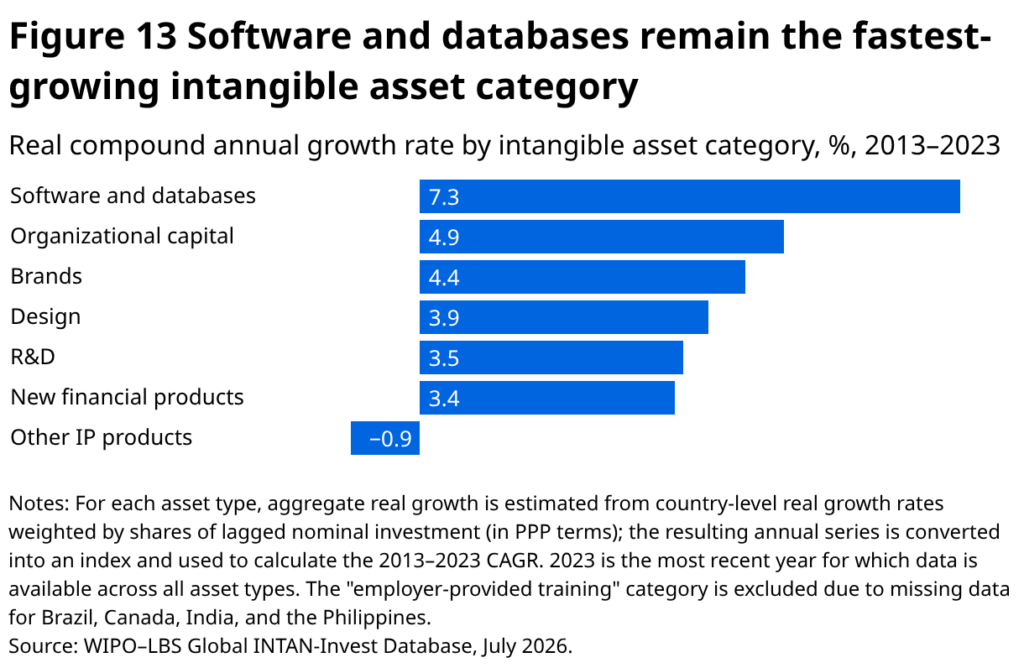
The report identifies software and databases as the fastest-growing category of intangible assets worldwide. Between 2013 and 2023, investment in these assets grew at an average annual rate of 7.3%, fuelled by digital transformation and the rapid adoption of artificial intelligence. Organisational capital followed with growth of 4.9%, while brand investment increased by 4.4%.
According to WIPO, artificial intelligence is accelerating demand for intangible assets across virtually every sector of the economy. Beyond investments in data centres and computing infrastructure, AI’s long-term economic impact lies in software development, data management, research activities, organisational transformation, workforce skills and the creation of new business models.
In this environment, the ability to create, manage and protect intangible assets is becoming one of the most important drivers of competitiveness for innovative organisations.
Brands emerge as a strategic asset worth more than EUR 1.2 trillion
One of the report’s key themes this year is the growing economic importance of brands.
WIPO estimates that global investment in brand creation and development reached approximately EUR 1.2 trillion in 2025, making it one of the world’s largest investment categories and a key contributor to economic value creation.
In an environment increasingly shaped by AI-generated content, brands are becoming essential signals of trust, authenticity and differentiation. Their ability to strengthen customer relationships, support international expansion, protect corporate reputation and generate long-term value explains their growing significance within the intangible economy.
Europe continues to strengthen its knowledge-based economy
Europe is steadily consolidating its transition towards knowledge-intensive growth models. Sweden leads the global ranking for intangible investment intensity, with investment equivalent to 17.4% of GDP. It is followed by the United States at 15.6%, France at 15.2%, and Denmark and Finland, both close to 15%.
The report also highlights the strong momentum of countries such as Lithuania, Estonia, Romania, Slovakia and Slovenia, all of which are rapidly increasing investment in innovation-related and digital assets.
Overall, the findings suggest that the most competitive economies are those capable of combining technology investment, research, talent, intellectual property and brand development to generate sustainable long-term advantages.
Spain: intangible assets gain ground as a driver of competitiveness
Spain features among Europe’s leading economies in terms of total investment in intangible assets. According to the report, intangible investment represents approximately 8% of Spanish GDP, reflecting the growing importance of innovation, knowledge and intellectual property within the country’s economic fabric. While Spain remains below the levels achieved by Europe’s most knowledge-intensive economies, it has established a significant base of investment in intangible assets and ranks among the continent’s largest economies in terms of overall intangible investment.
The report also places Spain among Europe’s leading countries for investment in brands, with expenditure exceeding EUR 38 billion. This underlines the increasing importance of corporate reputation, internationalisation strategies and competitive differentiation for Spanish businesses.
Spain is also among the fifteen largest economies analysed in terms of recent growth in intangible investment, recording annual growth of 3.1%, outperforming several established European economies including France, the United Kingdom, Italy, Sweden and Denmark.
The country’s position among Europe’s leading economies in both overall intangible investment and brand investment highlights the growing role of intellectual property assets in economic value creation. Brands, patents, designs, software, data and specialised knowledge are increasingly becoming essential tools for driving innovation, international growth and business competitiveness.
The findings also suggest that Spain still has considerable room to close the gap with the most intangible-intensive economies in Northern Europe. This represents a significant opportunity to strengthen investment in innovation, technology, research and the protection of intangible assets as key levers for productivity growth and long-term competitiveness.
About the report
World Intangible Investment Highlights 2026 is jointly published by the World Intellectual Property Organization (WIPO) and Luiss Business School and is based on the Global INTAN-Invest database. The 2026 edition analyses 29 economies representing approximately 57% of global GDP and provides one of the most comprehensive assessments currently available of global investment in intangible assets. The report covers categories including software, databases, research and development, design, brands, organisational capital and other innovation-related assets, offering valuable insights into the factors driving productivity, competitiveness and economic growth in the knowledge economy.
The full report can be downloaded from the WIPO website: World Intangible Investment Highlights 2026.


