

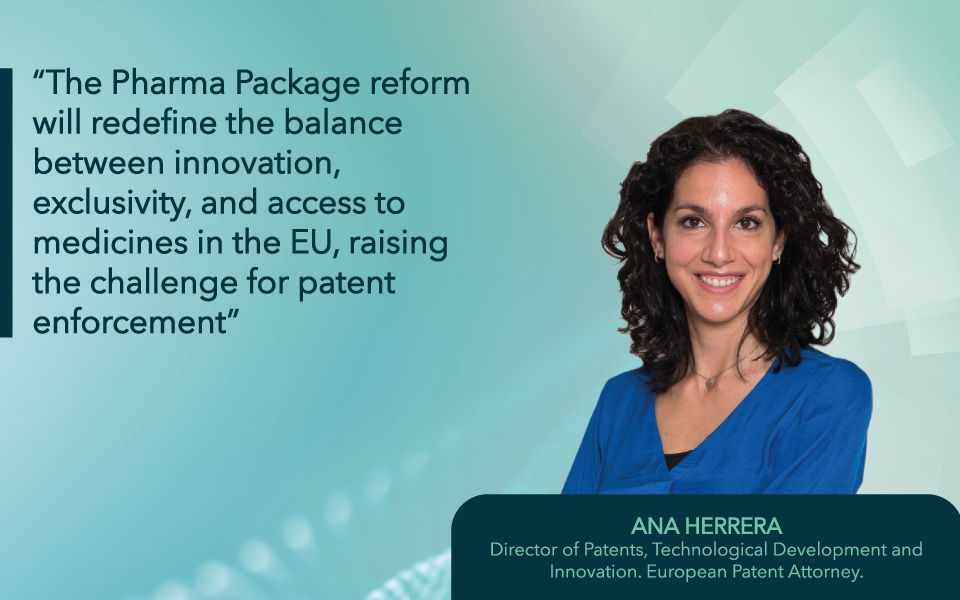
Last December, the Council and the European Parliament reached an agreement on the “Pharma package”, which is an updated set of rules that aims to safely, justly, efficiently, affordably and fairly improve patient access to drugs, reduce regulatory burden and, lastly, strengthen competitiveness in the European pharmaceutical industry in relation to other regions outside the EU, such as Asia and the US.
While endorsement, and therefore formal adoption and entry into force, are still pending, the recent pharmaceutical reform of the so-called “Pharma Package” is, for some, a significant change in the European Union rules regarding the regulatory exclusivity for new medicines, entailing a major update in this regard in the last 20 years, while for others, the proposed measures are inadequate and come too late.
In any case, the spirit of the reform is to seek a balance in the delicate tandem of innovation/exclusivity and market access/availability of medicines by essentially modifying the periods and conditions for obtaining exclusivity in the market. The reform is therefore a significant structural change that redefines the regulatory and strategic landscape for the exclusivity and market access of medicines in Europe.
Specifically, under the new scheme, the exclusivity model that the innovator can benefit from is structured as follows: 8 years of data protection (during this period, other rival companies cannot use the data relating to the preclinical and clinical results filed by the owner of the marketing authorisation of a medicine) + 1 year of market exclusivity (during which time a generic or biosimilar cannot be marketed by any third party) + up to 2 additional years if the innovative medicament meet a series of conditions, such as being a medicine that addresses an unmet medical need, the trials were performed in the EU, it is a new therapeutic indication or it is an antimicrobial drug against current antibiotic-resistant bacteria.
This regulatory exclusivity, which is reconfigured beyond the previous 8+2(+1) that combined 8 years of data protection, 2 years of market exclusivity and 1 year for a new indication, establishes a more reduced standard basis of 8+1, but with a modular model that makes it possible to reach 11 years, rewarding continuous innovation and new indications, as well as promoting availability and access of the medicine in the EU.
However, the first apparent consequence of this shorter basic duration of the regulatory exclusivity is that it may form a dependency, and if possible, put greater importance on patents and Supplementary Protection Certificates (SPC). More than ever, patent strategy will therefore become crucial for innovators, who will have to continue developing and improving their medicines in order to extend their market exclusivity period as much as possible. In this way, it will be strategically important to protect additional indications, formulations and improvements that, on the one hand, increase the company’s patent portfolio and, on the other hand, extend the exclusivity provided for in the new regulation.
With regards to orphan medicines, the previous regulation provided 10 years of exclusivity without distinction; however, the new regulation introduces 9 years for standard orphan medicines and 11 years for those covering diseases with no therapeutic alternative, with the possibility of an additional year for new indications or market access. As a result, the patent strategy and planning for orphan medicines should once again consider patenting sufficiently novel and inventive improvements that justify this additional exclusivity.
Furthermore, in this new regulation, antimicrobial medicines arise as a priority as they can become a transferable voucher which will inevitably be reflected in the exchange and transfer of IP assets.
The so-called Transferable Exclusivity Voucher (TEV) gives companies an additional year of regulatory protection that can be applied to a priority antimicrobial medicine or another authorised medicine of their choice or sold to third parties. It is a new form of exclusivity that can be used to leverage the management of the portfolio life cycle of this type of product within the company and which can be combined with the management and transfer strategy, among others, of patents on antibiotics to maximise their value.
Lastly, the extended Bolar exemption provided by the new regulation is probably the part of the reform with the greatest impact on defending patents and the activities to enforce them against third parties and prevent infringement. This is due to the fact that the scope of this Bolar exemption is broadened to allow generic and biosimilar manufacturers to adopt and start the necessary preparation activities to assess the medicine (studies and trials) in order to obtain the marketing authorisation, price approval, reimbursement and bids, with the exception of placement on the market, during the exclusivity period of the innovative product (original). In other words, patent rights are not infringed when any of these activities are performed. As such, the aim is to ensure that these generic medicines are available on the market on day one after the patent protecting the innovative medicine has expired. However, a number of collectives have already warned of the problems that this broadening will bring, as well as the uncertainty it will create. This measure, which together with the updated regulation that simplifies the EMA’s processing of marketing authorisation applications, will cause more frequent and, above all, earlier launches of generics/biosimilar on the market, which has the potential to discourage innovative activity. Moreover, it will also be even more crucial for holders of IP rights to monitor possible unauthorised uses that generics companies may be making of collected data when assessing and preparing their products for market.
In conclusion, the new framework regulates regulatory bodies, but ultimately, the efficacy of the mechanisms that allow a medicine to benefit from the maximum exclusivity on the market continues to be implementing and having suitable industrial property protection and management, which should continue to be at the heart of the system. Reducing the “basic” protection provided by this new regulation will cause the protection of portfolios to be strengthened with strategic patents (divisional, improvements, new indications). Although the modular incentives for innovation and TEV provide new opportunities, they also require rigour and patents must be at the forefront when suitably covering and protecting these specificities.
In any case, the professionals of this sector consider that this reform calls for adaptation since, in addition to working to obtain patents and having a strong portfolio, this protection will need to align with medical evidence, regulatory context and territorial access. Those who are capable of achieving this balance will be strengthened and, ultimately, the key will be regulatory-IP synergy: integrating trial planning, clinical development and patent strategy to acquire as many years of exclusivity as possible.
Written by: Ana Herrera. Director of Patents, Technological Development and Innovation at PONS IP. European Patent Attorney.


