

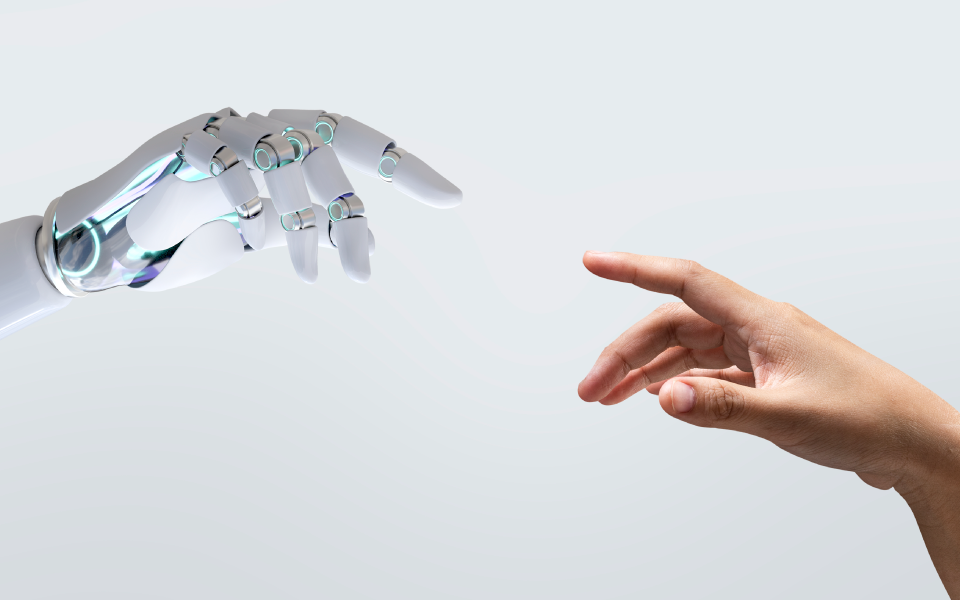
For years, social robotics has been stuck in a state of perpetual promise. We have seen prototypes, demonstrations and significant technological advances, but their presence in our daily lives was still limited. However, something has changed.
The work we have carried out at PONS IP, which is set out in our study on Applied Robotics, Social Robotics and Artificial Intelligence, confirms that we are entering a new phase: a phase of maturity. Not because the technologies are new, but because, for the first time, three key factors are coming together: the consolidation of enabling technologies, growing structural pressure in sectors such as education and social and healthcare services, and the emergence of artificial intelligence as a natural interface between technology and people.
This turning point is also reflected in the data, with more than 675 patent families registered in the field of social robotics over the last five years, and a grant rate showing that the sector has moved beyond the experimental phase and is now focusing on the practical application and commercial exploitation. This is therefore not a nascent trend, but rather a technology that is beginning to establish itself as an infrastructure.
But perhaps one of the most significant findings of this study is not just growth, but the nature of that growth. Practical robotics is not advancing in the same way as other digital technologies, through widespread and rapid adoption. It does so in a gradual, systematic and deliberate manner, becoming embedded in areas where human interaction is critical, such as education, healthcare and public services. Not with the intention of replacing, but rather of supporting and interacting with it.
And it is precisely in this interaction that a dimension emerges which, until recently, seemed alien to the world of robotics engineering: emotion.
During the catalogue launch event, this idea ceased to be merely abstract. Seeing technologies such as exoskeletons for children, which can restore mobility, autonomy and hope to children and their families, made it clear that we are entering a new era. An era in which robotics not only solves functional problems, but also has a real human impact. Robotics that inevitably takes on an emotional dimension.
A few years ago, it would have seemed strange to mention robotics and emotion in the same sentence. Today, it is not only possible, but necessary. Because true progress does not lie in technical sophistication, but in the ability to design systems that become part of people’s lives, that support them, care for them and expand their possibilities.
In this context, artificial intelligence plays a decisive role, but not in the usual sense. Not as an autonomous and unpredictable system, but as a controlled engine that enables the robot’s behaviour to be adapted, the context to be interpreted, and coherent, comprehensible interactions to be maintained. The key is not autonomy, but trust.
And this is where an element comes into play that is often overlooked, yet is essential: intellectual property.
In a field such as social robotics, where multiple technologies converge and where innovation is inherently collaborative, intellectual property cannot be viewed as a defensive mechanism. It is, above all, a tool for structuring. It enables technology transfer, facilitates collaboration, allows solutions to be scaled up, and provides legal certainty in environments involving businesses, research centres and public authorities.
The analysis clearly shows that the future of practical robotics will depend not only on technological development, but also on the ability to build robust ecosystems of transfer and cooperation. And that is only possible if intangible assets are properly identified, protected and managed.
A number of clear recommendations can be drawn from this perspective.
Firstly, organisations that develop or implement robotics and artificial intelligence solutions must incorporate an intellectual property strategy from the outset, rather than as a subsequent step. Protection is not the end of the process, but part of the design of innovation.
Secondly, we need to move towards more sophisticated transfer models that combine licensing, co-development and the shared use of technology platforms. Practical robotics is not sold as a finished product; it is deployed as a capability.
Thirdly, it is essential to identify and protect not only the core technology, but also the distinctive features: interaction models, sector-specific applications and specific AI integrations. That is where much of the value is created.
And finally, we must assume that the competitive advantage will not lie solely in technology, but in the ability to integrate it into real-world contexts, within appropriate frameworks of trust, regulation and collaboration.
In conclusion, social robotics is no longer just a promise. It is starting to become a part of our institutions and our daily lives. The question is no longer whether it will arrive, but how we design it, how we protect it and how we share it.
Written by: Isabel Marco. Head of Innovation Projects at PONS IP


