

Guillermo Criado. Director of International Business Development.
The recent judgment handed down by the 14th Civil Division of the Düsseldorf Regional Court in the case of Fender Musical Instruments Corporation v. Yiwu Philharmonic Musical Instruments Co. (14c O 64/25) confirms, in the defendant’s absence, that the design of the body of the Fender Stratocaster guitar constitutes a work protected by copyright in Germany. It further states that the commercialisation of guitars that substantially reproduce that shape constitutes an infringement of the right of reproduction (Vervielfältigung). The court prohibits its distribution within Germany, subject to a fine or a prison sentence in lieu thereof and orders the defendant to pay costs.
The ruling stands out for its rigorous integration of the doctrine of the Court of Justice of the European Union, in particular the Cofemel and Mio/Konektra judgments, as well as the case law of the Bundesgerichtshof, with references to precedents such as Birkenstocksandale and Vitrinenleuchte. The result is a particularly useful guide for the protection of iconic products in the context of the digital economy and global commercialisation.
Fender, which has held the exploitation rights to the Stratocaster body design since 1985, brought proceedings against a seller based in China who was offering guitars via AliExpress, expressly targeting customers in Germany. In order to establish the relevant market and the actual placing on the market within Germany, the claimant carried out a test purchase with delivery to Meerbusch. On the basis of this evidence, the court finds that the German courts have international jurisdiction by virtue of the place where the harmful event occurred, in accordance with Article 32 of the German Code of Civil Procedure (ZPO), and confirms their subject-matter jurisdiction by reference to German Copyright Law (UrhG) and organic legislation. This approach is consistent with the established case law of the Federal Court of Justice (BGH), which recognises the jurisdiction of the court where the harmful effect occurs, including in e-commerce contexts.
The legal basis of the decision lies in the classification of the Stratocaster’s body as a work of applied art (angewandte Kunst), within the meaning of Articles 2.1.4 and 2.2 of the German Copyright Law. The court notes that, as the work was created in 1954, prior to the entry into force of the German Copyright Law of 1965, it is necessary to assess protection in accordance with the German-US Convention of 1892 and under historical German legislation, in particular the Short-time Work Allowance (KUG) of 1907. This framework guarantees copyright protection in Germany for a term which, calculated post mortem auctoris, extends at least until 2041. Protection, therefore, does not depend on the validity of the law in the United States, but exclusively on German law, in line with the Federal Court of Justice’s Tarzan precedent.
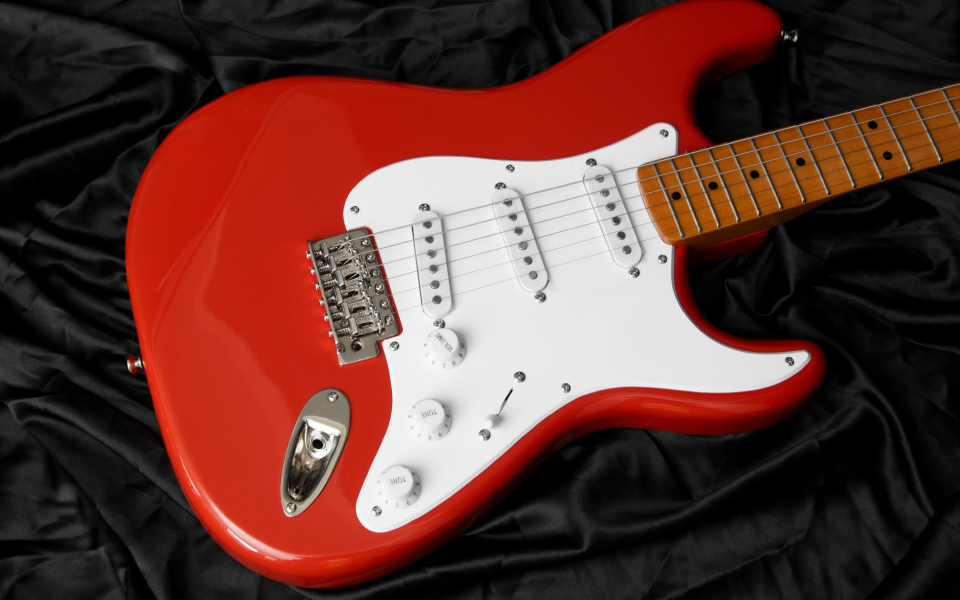
Applying the CJEU’s standards of originality—which define a work as an intellectual creation of its own that reflects the author’s free and creative decisions and is identifiable with precision and objectivity—and those of the Federal Court of Justice, which focus on the individual imprint and the expression of the creator’s personality, the court analyses the morphology of the Stratocaster’s body. It highlights the deliberate asymmetry, the gentle curves, the proportions and three-dimensional recesses, as well as the integration of the pickguard and the cable outlet as compositional elements. Taken as a whole, these features confer an unmistakable identity on the design. The analysis explicitly draws on the Cofemel doctrine and, in particular, the 2025 Mio/Konektra judgment, which clarifies that a marked aesthetic effect is not sufficient in itself, but that the combination of creative elements may reveal the author’s personal imprint.
The infringement: substantial reproduction of the creative core
Based on the screenshots of the advertisement and the test purchase, the court concludes that the guitar on offer replicates the external shape of the body, the configuration and attachment of the pickguard, and the position of the cable outlet. It even replicates the rear recess with a virtually identical width. The comparison is not limited to general proportions, but focuses on matching dimensions and the very combination of elements that embody Leo Fender’s creativity. In accordance with Article 16 of the German Copyright Law, read in conjunction with Article 23(1) concerning adaptations, not only do identical copies constitute an infringement, but so do variations that retain the protected creative elements in a recognisable form. This interpretation has been confirmed both by the Federal Court of Justice in Vitrinenleuchte and by the CJEU in Mio/Konektra, which emphasised that an infringement may occur even where a relatively small part of the work is used, provided that it incorporates recognisable creative elements.
The court also dispels two common objections. Firstly, it dismisses the relevance of the absence of the Fender logo or colour differences, as this is a dispute centred exclusively on the shape as a protected work, and not on distinctive signs or colour elements. Secondly, it rejects the notion that creativity depends on a supposed “level of design”. Following Cofemel and Mio/Konektra, the scope of protection does not vary according to the degree of creative freedom or abstract thresholds, but rather according to the originality and recognisability of the elements that reflect the author’s personality.
Measures, evidence and the risk of recurrence
The ban on commercialisation within Germany is enforceable by way of a fine of up to €250,000 per infringement or a prison sentence in lieu thereof of up to six months per infringement, subject to a maximum of two years. The ruling is provisionally enforceable and includes an order to pay costs. Test purchases play a key role as evidence to establish competition and prove that an act of commercialisation has taken place in Germany. Furthermore, the court notes that the risk of recurrence (Wiederholungsgefahr) is presumed once the offence has been committed and can only be countered by a cease-and-desist order containing a penalty clause, in accordance with the established case law of the Federal Court of Justice.
The judgment sends a clear message to those who manage iconic designs. Copyright proves to be a particularly powerful tool when originality and distinctiveness are combined, offering potentially longer-lasting coverage than that afforded by registered designs for products with long life cycles. Its effectiveness is maximised when integrated into multi-layered strategies that combine copyright, three-dimensional trademarks, designs and actions against unfair competition, with the aim of protecting exclusivity in the face of global marketplaces. In the e-commerce environment, it is sufficient to demonstrate that the forum is effectively customer-oriented and to carry out a test purchase to establish competition and prove market entry. Finally, risk management in the supply chain requires reviewing catalogues, fact sheets and images, and documenting due diligence—the well-known ‘know your seller’ principle—as distributors, platform sellers and non-EU manufacturers are exposed when the product is directed at the European market.
Beyond the music sector, this approach is fully applicable to sectors such as furniture, footwear, consumer electronics, household goods, toys and fashion, where iconic design acts as a hallmark and a driver of economic value. The judgment calls for a review of portfolios to identify designs with a defensible personal imprint, to update evidence of creation and disclosure, and to establish protocols for monitoring and rapid response on digital platforms.
The judgment in Fender v. Yiwu thus places Europe at the forefront of design protection through copyright. It confirms that where form embodies creative decisions reflecting the author’s personality, its reproduction—even if not identical or incorporating the trademark—constitutes an infringement. In a global market dominated by technology platforms, the ruling offers a clearly actionable roadmap for the defence of iconic intangible assets and consolidates the convergence between the doctrine of the CJEU and German case law on works of applied art.


