

Can a political party use a famous trade mark to strengthen its message and then argue that it is merely exercising its right to freedom of expression?
In its judgment of 8 September 2026 in Case C-298/23, Inter IKEA Systems BV v Algemeen Vlaams Belang VZW and Others, the Court of Justice of the European Union (CJEU) answered that question with a qualified yes: but only where it can be shown that freedom of expression outweighs the trade mark proprietor’s rights. Simply invoking freedom of expression is not enough.
On 14 November 2022, the Belgian political party Vlaams Belang launched its proposed reform of asylum and immigration policy under the title“IKEA-PLAN – Immigratie Kan Echt Anders” (“the IKEA Plan: Immigration Really Can Be Different”). The campaign consisted of fifteen proposals described as “ready to assemble” and was illustrated using IKEA trade marks and figures resembling those featured in IKEA assembly instructions. The campaign was disseminated via the party’s website and social media channels.
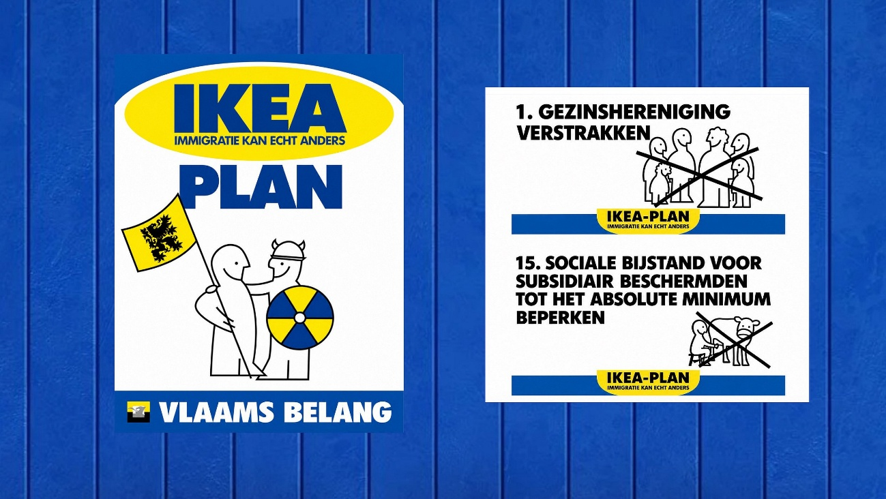
Inter IKEA Systems (IKEA), proprietor of three Benelux trade marks and one EU trade mark, brought infringement proceedings against Vrijheidsfonds, the association that finances and supports the party and which carried out the campaign on its behalf.

Vrijheidsfonds acknowledged that it had used the trade marks without consent and undertook to cease doing so for the duration of the proceedings. Its defence was that there was “due cause” for the use, as it formed part of a political debate protected under Article 11 of the Charter of Fundamental Rights of the European Union.
The Dutch-speaking Enterprise Court of Brussels referred questions to the CJEU for a preliminary ruling. It asked whether freedom of expression, including political parody, could constitute “due cause” within the meaning of Article 9(2)(c) of Regulation 2017/1001 and Articles 10(2)(c) and 10(6) of Directive 2015/2436, and what criteria should govern the balancing of that freedom against property rights.
A non-existent exception and the concept that fills the gap
A reputed trade mark enjoys enhanced protection. Its proprietor may prohibit the use of an identical or similar sign, even in the absence of a likelihood of confusion or identity of goods and services, where such use, without due cause, takes unfair advantage of, or is detrimental to, the distinctive character or reputation of the trade mark.
This is the crux of the case. While copyright law expressly provides for exceptions for caricature, parody and pastiche under Directive 2001/29, EU trade mark law contains no equivalent express exception. During the legislative process for both the Directive and the Regulation, the European Parliament proposed introducing a limitation for parody, artistic expression, criticism and commentary, but this proposal was ultimately not adopted.
For reputed trade marks, the only avenue through which freedom of expression may be balanced against trade mark rights is the concept of“due cause”, a notion left undefined by the legislation.
For this reason, the referring Belgian court, noting that Belgian courts tend to interpret the concept restrictively while Dutch courts take a broader approach, asked whether freedom of expression, including political parody, could amount to due cause and, if so, according to what criteria it should be weighed against property rights.
The Court began by recognising that the legislation does not clarify the meaning of the concept. However, it recalled that the recitals to the relevant legislation emphasise the need to apply its provisions with full respect for fundamental rights and freedoms, particularly freedom of expression. Consequently, freedom of expression may, in principle, constitute due cause.
That said, merely invoking freedom of expression is insufficient. A party making use of a third party’s trade mark must set out the specific reasons why that use constitutes an exercise of freedom of expression and demonstrate that those reasons outweigh the rights and interests of the trade mark proprietor. Otherwise, the concept of due cause would be deprived of any substantive meaning.
According to the published analysis of the judgment, national courts must consider two principal factors when carrying out this balancing exercise.
The first concerns the intention and good faith of the user. The use must convey an idea connected with the trade mark, contribute to a debate of general interest, or respond to another genuine need, such as a linguistic necessity. Where the sole purpose is to benefit from the reputation of the trade mark, due cause will not exist.
The second concerns the relative weight of the competing rights. Relevant considerations include the contribution made by the use to a debate of general interest, whether the use is commercial in nature, its satirical or parodic character, and its consequences for the trade mark proprietor. The intensity and scope of the use, the degree of similarity between the signs, and the risk that the public may perceive the trade mark proprietor as endorsing the message are also significant factors.
As regards Article 10(6) of the Directive, which allows Member States to protect trade marks against uses other than those relating to the indication of goods or services, commentary on the judgment suggests that the same analytical framework applies. However, in light of the case law of the European Court of Human Rights, expression outside the strictly commercial sphere may enjoy broader protection, meaning that the outcome of the balancing exercise need not necessarily be identical to that under Article 10(2)(c).
Applying those principles to the facts of the case, the Court considered that the use of the IKEA trade marks was capable of causing significant harm to their reputation and to the interests of their proprietor. Although the final decision formally remains with the referring court, the CJEU’s reasoning leaves little room for doubt. The acronym IKEA has no meaning that made its use necessary, nor does it appear to have become a cultural reference point. The debate on immigration bears no connection to the trade marks. The signs used were highly similar, including the typography and colour scheme. The use was repeated and widely disseminated online, and it could not be ruled out that the public might perceive IKEA as supporting the proposed reform programme.
All of this suggests that a use whose sole purpose was to exploit the reputation of the trade marks in order to reinforce and disseminate a political message cannot prevail.
What changes in practice?
For proprietors of reputed trade marks, the judgment is welcome news, albeit with important nuances. It confirms that such trade marks are not immune from freedom of expression claims, but the threshold for relying on that freedom is high. Where the message bears no connection whatsoever to the trade mark, proprietors are in a strong position. It will be important to gather evidence relating to the degree of similarity between the signs, the extent of the use, and the risk that the public may associate the trade mark with the message, as these are the factors that courts will weigh in the balance.
For those using third-party trade marks for expressive purposes, neither parody nor a political context constitutes an automatic defence. What matters is the link between the message and the trade mark. Criticism or satire directed at the trade mark itself, its proprietor or its products is more likely to be acceptable than using the trade mark merely as an attention-grabbing device. The extent to which the sign departs from the original and introduces its own creative contribution will also be relevant.
From a systemic perspective, the Court has chosen to resolve the conflict through an open-ended legal concept rather than a statutory exception. Inevitably, national courts will now be required to refine the applicable standard on a case-by-case basis.
The case now returns to Brussels for a final determination in light of these guidelines. All indications suggest that the IKEA-PLAN will remain something that cannot be assembled using somebody else’s pieces.


