


Based on the official China National Intellectual Property Administration (hereinafter referred to as “CNIPA”) data from 2019 to 2024, while major European industrial powers like Germany, France, Italy, and Sweden have seen their application volumes stagnate or decline over the last five years, Spain’s volume rose steadily from 421(2019) to 494 (2024) applications[1] with a compound annual growth rate of 3.25%. It has become one of the fastest-growing European contributors to the Chinese patent landscape.
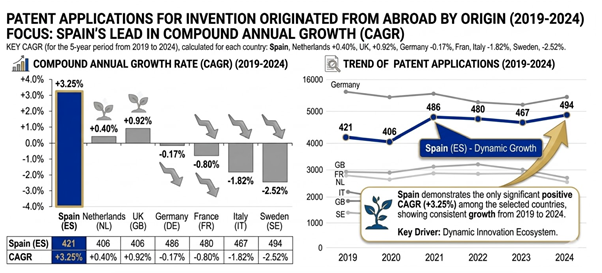
Spanish companies especially those with deep AI and big data expertise in automotive, renewable energy, telecommunications, or medical technologies are increasingly prioritising the Chinese market for intellectual property protection.
As we move through 2026, China has transitioned from broad policy outlines to granular, enforceable standards Success in the Chinese market now requires more than just innovation; it demands a sophisticated understanding of localised legal frameworks. The recent updates by the CNIPA, specifically Order No. 84 (issued November 2025, effective January 1, 2026), represent a major shift in how AI and big data are treated.
This revision mainly includes the following aspects:
1 – The “Natural Person” Mandate
Decree 84 explicitly forbids naming “AI” as an inventor, and requires that an inventor must have made a substantive creative contribution to the “essential technical features” of the invention.
The inventor is required to fill in their nationality (if Chinese, their ID card number is required) as their identity information. For non-Chinese inventors: full name and nationality are required (ID numbers will not be mandatory).
2 – This revision strengthens the substantive examination logic of “exchanging disclosure for protection”.
By requiring the specification to record in detail the logical relationship between the AI model’s architecture, training parameters and application scenarios (6.3.1), it provides examiners with clear basis for seeking support from the specification when judging technical attributes or inventiveness (6.1), thereby ensuring the feasibility and technicality of high-precision AI solutions.
The first sentence of the “6.1 Examination Standards” section is amended to “The examination shall be conducted on the claimed solution, that is, the solution defined in the claims, and, where necessary, the content of the specification shall be examined”, which adds “where necessary, the content of the specification shall be examined”.
For Spanish companies, filing with the European Patent Office (EPO) often involves concise algorithm descriptions, as the EPO prioritises the algorithm’s contribution to solving the technical problem. However, in China, this new rule means examiners will be more proactive in reviewing the specification to identify “substantial innovation.” Under the new regulations, examiners will use the specifications to determine whether the applicant’s big data solution is merely “pure business logic” or “pure mathematical game”.
The following new provision is added to the “6.3.1 Drafting of the Specification” section: “If the construction or training of an artificial intelligence model is involved, the specification shall generally clearly describe the necessary modules, levels or connections of the model, the specific steps and parameters required for training, etc. If the application of an artificial intelligence model or algorithm in a specific field or scenario is involved, the specification shall generally clearly describe how the model or algorithm is combined with the specific field or scenario, how the input and output data of the algorithm or model are set to show their inherent relationship, etc., so that those skilled in the art can realize the solution of the invention according to the contents of the specification.”
The biggest takeaway for Spanish companies from this amendment is that in China, the value of an AI patent no longer depends on “what sophisticated model you used,” but on “how meticulously you customised the model and solved a specific problem.” If your original European priority application (EP) is concise, be sure to take advantage of the initial amendment opportunity when entering the Chinese national phase (PCT Into China) to strengthen the description of the model structure and data relationships according to the requirements of 6.3.1. Avoid the “algorithm black box” approach, and record the necessary modules, levels, connections, and training steps and parameters.
Companies would also need to carefully assess the boundaries between “patent protection” and “trade secret protection.” If certain parameters of a core algorithm are a company’s absolute core competency and cannot be obtained through reverse engineering, they should perhaps consider protecting them as a Trade Secret.
3 – The algorithm must be “good” and “law-abiding“.
“6.1.1 Examination according to Article 5, Paragraph 1 of the Patent Law
For invention patent applications containing algorithmic features or business rules and methodological features, if the data collection, tag management, rule setting, recommendation decision-making, etc. contained content that violates the law, social morality, or harms the public interest, then according to Article 5, Paragraph 1 of the Patent Law, no patent right shall be granted.”
The refinement of this clause sends a clear signal: China is shifting from a purely “technical” review to a dual review of “technology + compliance” in its AI and big data oversight. Since Spanish companies are already operating under the stringent EU AI regulations, as long as these compliant technical means (such as debiasing, encryption, and transparency) are formally incorporated into the patent’s technical solution, they can become strong evidence to prove the “completeness” and “advanced nature” of the solution.
4 – Core rules for creative review: rejecting “simple scene replacement”; creating synergy between the algorithmic features and specific technical challenges and achieving unexpected technical results
If the algorithm model does not make substantial improvements for the new scenario, but merely changes the object to be identified (from an apple to a boat), the examiner will consider it to be an “obvious” replacement for those skilled in the art.
The creativity of AI patents no longer depends solely on “scenario innovation,” but also on “the depth of fine-tuning” and “the differentiation in problem-solving.”
For many Spanish industrial AI and energy AI companies, this means that they would need to clearly explain “how the algorithm is modified to adapt to the physical characteristics of the industry,”in order to obtain high-quality patent protection in China.
As China continues to refine its digital transformation, those who align their intellectual property strategies with these high-quality standards will be best positioned to lead. For the Spanish deep-tech community, the message is clear: In the Chinese AI market of 2026, the strongest protection belongs to those who can best explain the harmony between their code, their people, and their purpose.
[1] Patent Applications for Invention Originated from Abroad by Origin 2020,2021,2022,2023,2024 published by the China National Intellectual Property Administration (CNIPA)
Written by: Jialin Chen. International Business Development.


