

Television, Hotels and the Public Communication of Audiovisual Works in Colombia
Until a few years ago, arriving at a hotel, unpacking your luggage and switching on the television was almost a natural part of the guest experience. Films, television series, sports, international channels, documentaries, news and entertainment were all there, included as part of the room, just like the bed, the towels or the minibar.
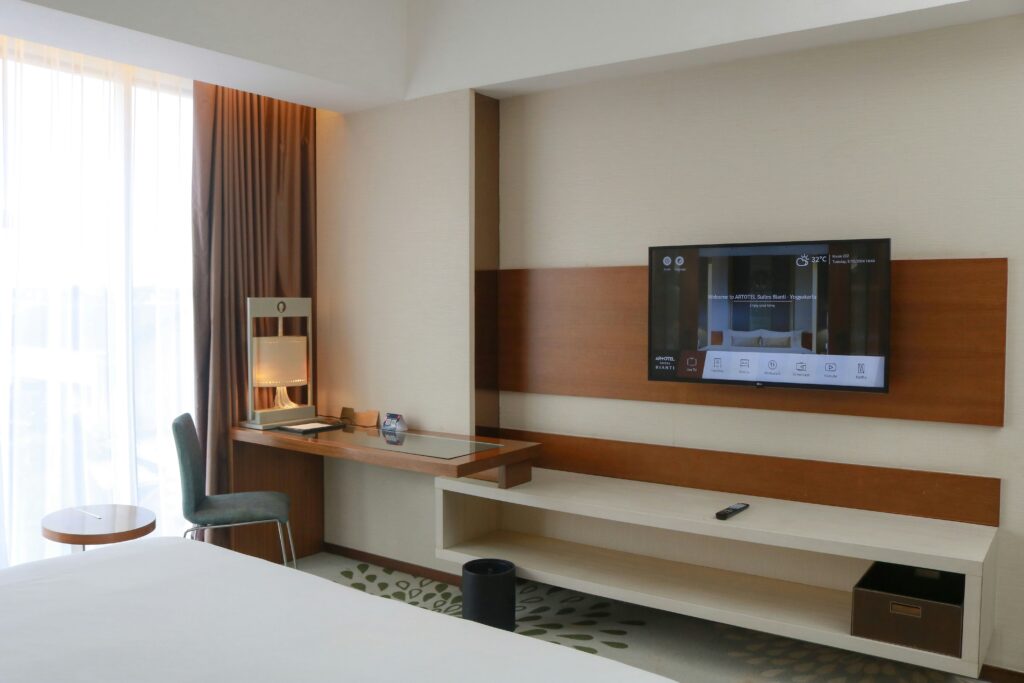
Today, however, many guests find a Smart TV, a handful of pre-installed applications and a subtle invitation to log in using their own accounts. In other words, the hotel provides the device, but the guest provides the content. For some, this may appear to be a reduction in service. For others, simply a technological adaptation. Yet behind this change there is also a legal and economic explanation: making audiovisual content available in hotels may constitute acts of public communication of works protected by copyright.
The issue recently returned to the spotlight following a decision of the Supreme Court of Chile dated 6 April 2026 (Case No. 22,850-2024), which upheld a judgment against a hotel company for the unauthorised use of protected audiovisual works through televisions made available in guest rooms and common areas. Although it is a foreign decision, the case is particularly relevant for the region because it addresses a highly practical question: can a hotel make films, television series, programmes or audiovisual content available to its guests without obtaining licences beyond those covered by payments made to its television service provider?
In Colombia, the short answer is: not necessarily.
Colombian and Andean legislation grants authors and holders of economic rights the authority to authorise or prohibit the public communication of their works. Andean Decision 351 of 1993 defines public communication as any act by which a plurality of persons may gain access to a work without prior distribution of copies. Likewise, Law 23 of 1982 recognises this right as one of the means through which protected works may be commercially exploited.
This means that when a hotel makes audiovisual content available to its guests through televisions, internal networks, subscription television systems or similar services, it is not necessarily engaging in a private or domestic use. Although the guest may be located within a private room, the service is being provided by a commercial establishment, in the course of an economic activity and for the benefit of a plurality of persons: its customers.
Indeed, the debate in Colombia is not new. As early as 1997, the Constitutional Court had already addressed the tension between privacy in hotel rooms and copyright protection. In Judgment C-282 of 1997, the Court declared unconstitutional a provision that sought to equate hotel rooms with private dwellings for the purpose of excluding the payment of copyright royalties. Since then, the discussion has proceeded from an important premise: the guest’s privacy within a hotel room is one thing, but the act of exploitation undertaken by the hotel when it makes protected content available to its customers is quite another.
The Andean Community has also expressly addressed this matter. In Preliminary Interpretation 44-IP-2020, the Court of Justice of the Andean Community examined the public communication of audiovisual works in hotels and other accommodation establishments. One of the significant aspects of this interpretation is that it does not necessarily require the guest actually to watch the work; it may be sufficient that the establishment makes it available or facilitates access to it as part of its commercial operations.
The issue has also seen more recent developments in Colombia. In Judgment SC424-2024, case file No. 11001-31-03-032-2019-00110-01, the Supreme Court of Justice analysed proceedings brought by EGEDA Colombia against Telmex Colombia S.A. — now Comcel S.A. — concerning the retransmission of audiovisual and cinematographic works by subscription television operators.
It is important to clarify that SC424-2024 was not a hotel-related case. It did not concern televisions in hotel rooms but rather the retransmission of free-to-air television signals by pay-TV operators. Nevertheless, the principle established by the Court is relevant to the present discussion: authorisation relating to a television signal does not necessarily amount to authorisation for the audiovisual works contained within that signal. In other words, contracting for or retransmitting a signal does not, in itself, ensure that all relevant copyright permissions have been secured.
This distinction is crucial for hotels. Engaging a television operator, installing decoding devices or allowing access to particular channels does not necessarily resolve all the authorisations required to communicate audiovisual works to guests. The legal analysis must go beyond the technological or connectivity service agreement.
This leads to another key point, and one of the most common misconceptions in commercial practice: the belief that copyright compliance in business establishments is limited to SAYCO and ACINPRO. This is not the case.
SAYCO, ACINPRO and the Sayco-Acinpro Organisation play an important role in relation to musical works, performers, artists and phonogram producers. For that reason, they are frequently involved in restaurants, bars, hotels, gyms and other establishments open to the public where music is played. However, when dealing with films, television series, television programmes, documentaries, sporting events and other audiovisual works, different rights and different rights holders come into play.
In Colombia, one particularly relevant organisation in this area is EGEDA Colombia, which administers the rights of audiovisual producers. Depending on the type of content involved and the manner in which it is used, other individual or collective rights holders may also be relevant, including producers, broadcasters, programme providers, actors, directors, screenwriters, broadcasting organisations, holders of rights in sporting events and collective management organisations authorised to represent particular repertoires.
For this reason, the correct question for a hotel should not simply be: “Have I already paid for my cable service and my SAYCO/ACINPRO licence?” Instead, the broader question should be: “Do I hold all the necessary authorisations for the content that I am making available to my guests?”
Comparative law has also addressed similar issues. In Europe, for example, case law has developed concepts such as the deliberate intervention of the establishment and the provision of access to a “new public” in relation to protected content. Without automatically transplanting those principles into Colombian law, they serve to illustrate that television in hotels is not analysed merely as a device placed in a room, but rather as part of an organised service that may carry legal and economic significance.
That said, the model based on Smart TVs, applications and personal accounts should not automatically be regarded as a complete solution. As a general principle, if guests use their own accounts, the situation may differ from that of a hotel that directly supplies a package of channels or audiovisual content. However, the answer will depend on the way in which the service is structured: whether the hotel merely supplies a neutral device, whether it pre-installs platforms, promotes access to particular content, integrates paid services, or uses such access as part of its commercial offering.
Accordingly, it is not enough simply to shift responsibility to the guest and assume the risk disappears. Each model must be assessed on its own merits.
This analysis is fundamental because the public communication of audiovisual content may give rise to claims not only from collective management organisations but also from individual rights holders. In certain circumstances, the absence of appropriate licences may result in financial claims, interim measures, litigation or contractual disputes with content providers.
From a business perspective, the issue should not be viewed solely as a legal risk but rather as part of the ordinary management of the business. If a hotel chooses to offer cable television, premium channels, films, sporting events or audiovisual content as part of its service experience — or even facilitates access to digital platforms through smart devices — it should review which rights are involved, what is actually covered by its agreements with operators or technology providers, what additional licences may be required and from whom such licences should be obtained.
In practice, some hotels have chosen to reduce their traditional channel offering, install Smart TVs that allow guests to use their own accounts, restrict access to certain content or negotiate specific licences tailored to their operations. These decisions may be driven by technological, commercial or user-experience considerations, but they may also form part of an intellectual property compliance strategy.
Therefore, as a guest, the next time you enter a hotel room and wonder why that seemingly endless range of channels is no longer available, the answer is unlikely to be simply that the hotel has become “stingy”. The reality may be that access to films, television series, sports and international channels represented a luxury carrying legal and economic costs that were not always visible to guests. But, like many luxuries, someone ultimately has to pay for it.
For hotel operators, the recommendation is clear: do not assume that the use of audiovisual content is automatically covered merely because televisions have been installed, a television operator has been engaged, or a music licence has been paid for. Every model of use — including Smart TVs linked to user accounts — should be analysed on a case-by-case basis, identifying the content involved, the relevant rights holders, any collective management organisations that may be engaged and the authorisations required.
At PONS IP, we assist companies in the hotel and hospitality sector with reviewing their content-use models, identifying the rights involved, negotiating licences and developing strategies to prevent infringements of third-party rights and potential claims by rights holders or collective management organisations.


